Grundschutz++ and OSCAL: openEduSuite's Machine-Readable Compliance Layer
In late October 2026 the BSI published Grundschutz++, the successor to its IT-Grundschutz methodology, together with a machine-readable requirements catalog in the OSCAL format. For the first time, a national security baseline arrives as data rather than as a printed compendium. openEduSuite has turned that into a published compliance layer: a pinned catalog, an OSCAL profile, a system security plan, an evidence ledger, and CI validation. This article explains what Grundschutz++ changes, how the layer works, and where the project's compliance status stands today, with all numbers taken from the repository at the time of writing.
This is a work-in-progress report. The machine-readable layer is live and CI-validated, but the status values are a self-assessment, not a certification, and 413 of the 652 requirements are still recorded as planned. The roadmap below states what ships, what is planned, and how the numbers are kept honest.
What Grundschutz++ changes
Grundschutz++, specified in BSI-Standard 300-1, is the BSI's modernized framework for information security management. Its requirements catalog, the Anwenderkatalog Grundschutz++, is published in the BSI's Stand der Technik Bibliothek and replaces the classic IT-Grundschutz-Kompendium.
Two changes matter most for a platform like openEduSuite:
- Requirements instead of modules. Where the compendium organized security around Bausteine (building blocks), the new catalog organizes it around requirements grouped into 20 practices, each with a stable identifier such as
GC.1.1orKONF.2.1. Every requirement carries metadata that machines can evaluate: a modal verb (MUSS, SOLLTE, KANN), a security level, an effort level, assigned threats, and the categories of target objects it applies to. - Machine-readable from day one. The catalog is distributed as JSON in the OSCAL format, explicitly so that requirements can be loaded into tools and checks can be automated. The BSI states that reducing the effort of running an ISMS through automation is a core goal of the framework.
For universities that standardized on the ZKI IT-Grundschutz-Profil, this is a migration: the profile text was written against the 2022 compendium, while the Grundschutz++ catalog uses its own identifiers and structure. The BSI publishes mapping collections to support the transition, which at the time of writing are still marked as draft. The earlier article on ZKI IT-Grundschutz compliance documents the starting point of this work; the layer described here is its continuation against the new catalog.
OSCAL, the format
OSCAL, the Open Security Controls Assessment Language, is a NIST standard for expressing security content as structured data. The three document types used here are the catalog (the requirements to comply with), the profile (which requirements apply and how), and the system security plan or SSP (how a specific system implements them, and with what evidence).
Because OSCAL is an interchange format rather than a vendor format, the same artifacts can be imported into different toolchains, compared, and diffed. That is precisely why the BSI chose it for the Stand der Technik Bibliothek: compliance reporting can be generated from data instead of being written up by hand.
Ecosystem note: the OSCAL Foundation is dissolving
On 10 November 2026 the OSCAL Foundation announced that it is dissolving. The nonprofit, founded in early 2025 to promote, develop, and internationalise OSCAL, cited a lack of demand; heise online reported the news (OSCAL Foundation löst sich auf).
It is worth stating precisely what this does and does not mean for this layer. OSCAL is a NIST standard; the foundation was a community body on top of it, not its owner. The BSI, whose Grundschutz++ catalogs this project pins and consumes, continues to publish in OSCAL and, according to the report, was itself surprised by the announcement, a sign of how young the distributed-catalog path still is.
For openEduSuite the dependency picture is unchanged in substance: the schemas pinned in the repository are NIST's, the catalog is BSI's, and every artifact is generated by the project's own tooling from committed data, not by a foundation-run service. Nothing in the pipeline stops working because the foundation winds down.
What changes is the risk picture at the margin: less community momentum around tooling, a trademarked name that a future fork could not keep, and less certainty that third-party OSCAL services continue to be maintained. These are recorded as an open risk in the register rather than ignored, and they are one more reason the artifacts are committed, diffable, and portable: the data outlives any single organization in the ecosystem.
The compliance layer
A pinned source of truth
The resolved Grundschutz++ catalog is pinned inside the repository, with its CC-BY-SA-4.0 licence noted and its provenance recorded, alongside pinned OSCAL 1.1.2 schemas. Updates are deliberate: a helper fetches a new catalog release, the structural changes are reviewed, and validation catches drift before anything divergent is committed. None of the checks run against a moving target.
One row per requirement
The layer's source of truth is a YAML ledger with one entry per requirement, currently 652 entries covering the top-level identifier of every requirement in the resolved catalog. Each entry records:
- scope: whether the requirement is in scope for the platform or not applicable
- status: implemented or planned
- evidence: which components in the repository back an implemented status
- remarks: context where needed
The ledger is generated deterministically from seed mappings rather than being edited by hand, so the statuses stay consistent and every regeneration is reproducible. A second file lists the evidence components with their paths in the repository, and a third carries system-level metadata such as the authorization boundary and sensitivity.
Deterministic build and validation
A build step turns ledger and catalog into an OSCAL profile and an OSCAL SSP, both committed so that every change is diffable in version control. A validator then checks four things: that the ledger is complete in both directions (no missing requirements, no orphans), that every referenced path exists, that the generated artifacts validate against the official OSCAL schemas, and that the committed build artifacts have not drifted from the current data. The layer is covered by 39 tests.
CI runs the validation on every relevant change. The current phase is validation-only, which reports without blocking; a blocking gate is planned as the next phase once the baseline is stable.
Where the compliance status stands
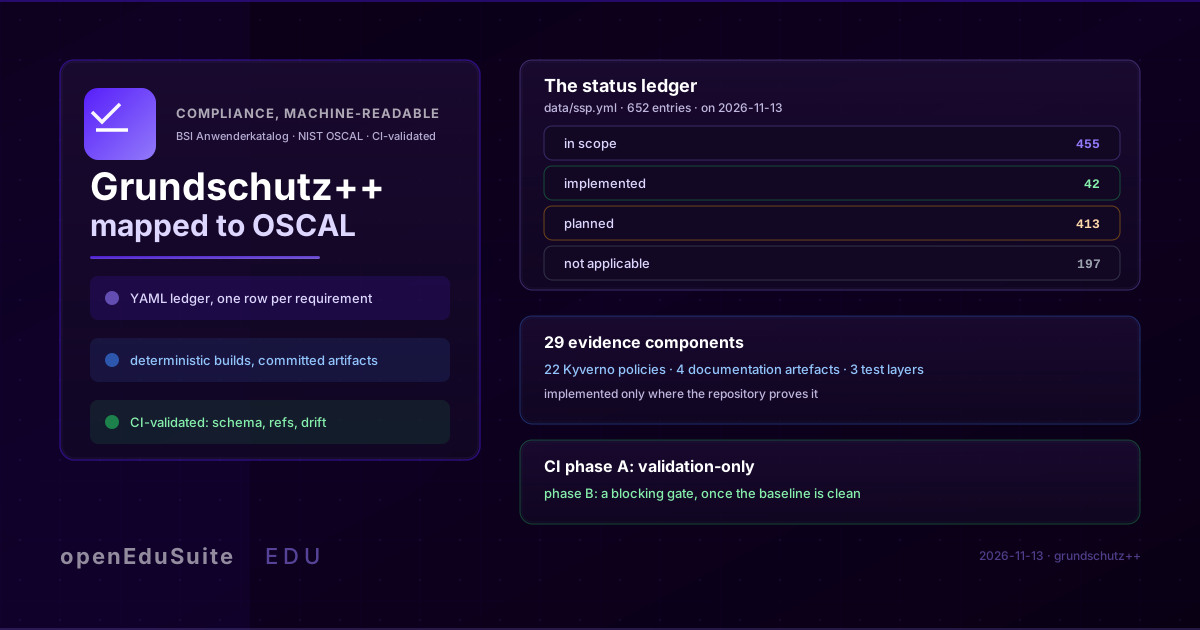
The numbers below are read from the committed ledger on 2026-11-13:
| Metric | Value | What it means |
|---|---|---|
| Catalog import | 652 requirements | Every top-level requirement of the resolved catalog is represented in the ledger |
| In scope | 455 | Requirements the platform itself must address |
| Implemented | 42 | Status backed by evidence in the repository |
| Planned | 413 | Requirements not yet evidenced; these are the open work |
| Not applicable | 197 | Organisational practices that live at the level of the operating institution |
| Evidence components | 29 | 22 Kyverno policies, 4 documentation artefacts, 3 test layers |
An implemented status is only granted where the repository contains something to point at: a Kyverno policy that denies non-compliant workloads, a documented process, or a test that exercises the control. The 22 Kyverno policies carried over from the ZKI alignment work, covering areas such as TLS at ingresses, non-root execution, capability dropping, network segmentation, and backup annotations, form the bulk of that evidence. The 413 planned requirements are the technical gap, stated openly rather than as a percentage.
The 197 not-applicable requirements are organisational practices: governance, personnel, buildings, awareness, and continuity planning. They belong to each operating institution and its ISMS, not to the platform, and the layer records that boundary explicitly instead of pretending a software project could satisfy them.
Evidence, not certificates
It is worth being precise about what this is and is not. The OSCAL layer is a machine-readable self-assessment, not a BSI certification and not an audit finding. The initial status values are estimates where evidence is still being collected; an implemented row is as strong as the artefact it points to, and the SSP is a living document whose correctness is the responsibility of the security and operations function.
The point of the exercise is that the assessment is now a set of reviewable files rather than a slide deck. Every row can be discussed file by file, every status can be checked by an independent party, and nothing is asserted that the repository cannot show.
What this means for universities
- Importable by design. An institution can load the SSP into its own ISMS tooling and reconcile it against its requirement package, using the same identifiers the BSI publishes.
- Comparable. Because the evidence keys off stable requirement IDs, different solutions can be compared on the same rows instead of against different self-written checklists.
- Migration-friendly. The Kyverno policy evidence carries across the move from the ZKI compendium era to Grundschutz++ largely unchanged, which is exactly the continuity a university migration needs.
- A complement, not a substitute. The platform's evidence covers the technical stack; the organisation's practices remain the institution's own ISMS work. The two fit together precisely because the layer documents the boundary between them.
Work in progress: the roadmap
The compliance layer is deliberately shipped in phases, and the phases are part of the public record:
- Phase A (live): validation-only CI. Every change is checked against the OSCAL schemas, the ledger completeness, the evidence paths, and drift, and results are reported without blocking.
- Phase B (planned): a blocking gate. Once the baseline is stable, CI moves from reporting to refusing changes that make the ledger inconsistent.
- Evidence refinement (ongoing): the 413 planned requirements move to implemented only as evidence lands in the repository, policy by policy.
- Catalog sync (ongoing): the pinned catalog follows new releases of the Stand der Technik Bibliothek, reviewed and committed deliberately.
- Ecosystem (new, contingency in place): the OSCAL Foundation announced its dissolution on 10 November 2026. NIST remains the owner of the OSCAL standard and the BSI continues publishing Grundschutz++ catalogs in OSCAL; this layer does not depend on the foundation. The residual ecosystem risk is tracked in the register; the written contingency — a tooling-independent artifact export path, pinned+fetchable NIST schemas and BSI catalog, and a re-verification step on every catalog sync — landed in
oscal/README.mdon 14 November 2026 (CG-005).
The numbers above are a snapshot read from the committed ledger on the date given. The ledger, the generated OSCAL artifacts, and this roadmap are public; the same values can be re-read by anyone at any time and are expected to change as the phases progress. On the institutional side, the SSP is intended to feed into the ISMS dialogue of adopting universities rather than replace it.
Call to Action
- Read the evidence: the Grundschutz++ overview on bsi.bund.de and the Stand der Technik Bibliothek on GitHub.
- Follow the method: compare the SSP approach with the supply-chain evidence pipeline, where the same principle is applied to the container layer.
- Community: feedback on the mapping and the status values is welcome in the openEduSuite community: matrix channel
#opendesk-ce-public:matrix.openedusuite.org.
Compliance as data: every row, every status, every artefact checkable.