The Latest Integrations: AI Workbenches, Fleet-Scale AI Assistance and Real-Time Collaboration
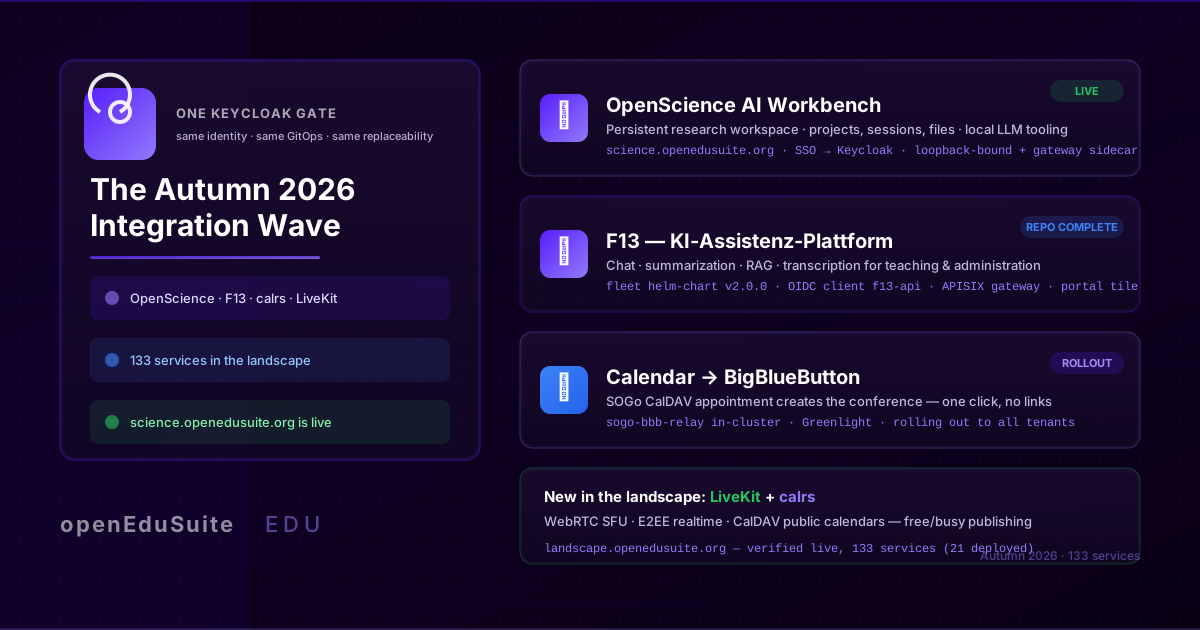
The openEduSuite integration wave of autumn 2026 follows a simple rule that has not changed since the platform's first release: every new service hangs off the same Keycloak gate, ships through the same GitOps pipeline, and remains replaceable. This post summarizes what has landed since the last integration round — an AI research workbench that is now productive, an AI assistance platform adopted as a fleet service, the calendar-to-conference path that is being driven to production, and the ecosystem additions to the public service landscape.
OpenScience: a research workbench inside the fence
The newest productive service is the OpenScience AI workbench at science.openedusuite.org. It is the first service in the suite that targets the researcher directly: a persistent workspace UI with projects, sessions and files, backed by local model and agent tooling. Two properties matter most from an operations point of view.
First, the runtime is loopback-bound. The server deliberately listens only on 127.0.0.1 inside its pod; it never owns a reachable endpoint of its own. A gateway sidecar in the same pod terminates public traffic, injects a bearer token into the upstream request, and exposes /global/health for the cluster probes. The policy is strict: no service that must not be reachable directly simply exists as a route — the pod is invisible to the network except for what the gateway publishes.
Second, SSO follows the same seamless gate pattern already used by Dify and the LMS: an oauth2-proxy instance in front, configured with --skip-provider-button so unauthenticated visitors are redirected straight to Keycloak (client openscience, OIDC) without an intermediate sign-in page. After login the user lands directly in their workspace. The deployment is entirely GitOps-driven: the image is built from the project's own Dockerfile into the cluster registry (openedusuite-nix/openscience, Apache-2.0), the manifests live in the monorepo, and ArgoCD reconciles both the application and its proxy. Data lives on a Ceph RBD volume with the platform's standard backup label — research state and code stay inside the data center by construction, not by paperwork.
F13: AI assistance as a fleet service
Where OpenScience is a workbench for researchers, F13 is the KI-Assistenz-Plattform for day-to-day assistance: chat, summarization, RAG and transcription for teaching and administration. openEduSuite adopted it as a fleet service — the upstream helm chart (f13 v2.0.0, F13 Core v4.0.0) is vendored verbatim into the repository (source: gitlab.opencode.de/f13/devops-tools/helm-chart), including its chart lockfile, without a single forked template.
The chart deploys three workloads (core:8000, frontend:9999, feedback:8000) and brings its own APISIX configuration as the ingress gateway. All credentials — feedback database, LLM API, transcription, message queue, object storage, and the Hugging Face token — are supplied as bundled Kubernetes secrets, provisioning SSO through a dedicated public OIDC client f13-api scoped to the F13 domain, and a portal tile appears in the landing dashboard. The repository part of this integration is complete; operator rollout to the cluster is the next step.
Calendar to conference: from appointment to BigBlueButton in one click
The integration that is currently being driven to production across the suite's tenants is native calendar-to-conference: a meeting scheduled in SOGo should carry its BigBlueButton session with it, without copy-pasting links. A relay service bridges the CalDAV world of SOGo and the BBB world of Greenlight: an appointment action creates the conference, and the meeting is one click away from the calendar entry. The middleware runs in-cluster (sogo-bbb-relay), and the tenant deployments (staff, students) are being aligned next so that the flow presents identically in every environment. The remaining work is rollout and tenant-by-tenant verification — the pattern itself is fixed.
The ecosystem in the landscape
To keep the platform's openness verifiable at a glance, the public service landscape (landscape.openedusuite.org) now maps 133 open-source services for education. The latest additions are the three services above and the real-time collaboration infrastructure:
- OpenScience (AI & Machine Learning) — the research workbench described above.
- LiveKit (Video Conferencing) — the open-source WebRTC media platform (SFU, end-to-end encryption) that powers low-latency real-time audio and video for collaboration spaces without proprietary media infrastructure.
- calrs (Email & Groupware) — a CalDAV-native public calendar publishing app that renders free/busy availability, complementing Radicale in the calendar stack.
The landscape is updated through the same discipline as every other artifact: data in version control, tests (data integrity, golden-file contract, browser E2E) in CI, and a documented deployment pipeline to production.
The rule has not changed
Every member of this wave — a research workbench, an AI assistance platform, a calendar bridge, a real-time media tier — followed the same three checks before it could count as integrated: same identity source, same GitOps path, same replaceability. The integrations keep coming; the gate stays the same.