OpenCloud 9.1.0 in openEduSuite: What the New Release Brings, and Images You Can Pull Publicly
The file sync and share service inside the openEduSuite digital workplace runs OpenCloud, an Apache-2.0 licensed platform developed by OpenCloud GmbH. Today the suite's production environment was updated to OpenCloud 9.1.0, the latest rolling release. For the first time, the exact image the production deployment runs is published on a publicly accessible container registry, pullable by anyone without an account or credentials.
What the 9.x line brings
OpenCloud releases follow three channels: rolling releases roughly every three weeks, production releases about every six months, and long-term support releases for subscribers. The 9.x line that began with 9.0.0 (October 27, 2026) and continues with 9.1.0 (November 11, 2026) carries the release series' most visible functional additions and a wave of hardening underneath.
Guest access by email (9.0). Sharing no longer requires that every participant has an account. A person without an account can be identified by their email address, receive a single-use link that is valid for a limited time, and work with the same access roles as an internal user, from viewer to editor. Unlike a plain public link, every guest access is tied to an identified person, logged, and revocable. This closes one of the classic gaps between self-hosted and SaaS file sharing without giving up on the sovereignty model.
OpenShift support in the official Helm chart (9.0). The deployment story broadened beyond a single container runtime; the documented packaging now covers OpenShift clusters as well.
Hardened request handling (9.1). The proxy layer no longer trusts forwarding headers blindly: the X-Forwarded-For middleware is only built when trusted proxies are configured, a deprecated IP middleware was replaced, and a missing role claim now yields a clean 403 instead of a 500. Health-check traffic is filtered from access logs and pod IPs.
More robust search and indexing (9.1). Full-text indexing memory is now bounded, the KQL search path is normalized once, rejected documents are reported when indexing to OpenSearch, and index updates skip unchanged facet keys. Edge cases such as out-of-range geopoint coordinates no longer break the index.
Operational clarity (9.0 and 9.1). The web front end shipped fix after fix for editors and media playback (motion and live photos), and the project added a design document for audit logging, a building block that matters for institutions with logging and compliance duties. The user-log service can now disable its HTTP and event consumers independently.
Release notes are published per version on GitHub (opencloud-eu/opencloud releases). The list above summarizes what changed on the path from 9.0.0 to 9.1.0.
Upgrade note for the 9.x line. The 9.x series reorganised how custom notification email templates are structured (from a single file to three: layout, message and digest). Deployments that override their own templates should follow the documented 9.x upgrade steps before switching.
The exact production image, publicly pullable
Inside openEduSuite, OpenCloud is built through the suite's Nix pipeline: the server source is pinned at a version, built as a reproducible NixOS container, scanned, signed, and equipped with a software bill of materials. The result is the same artifact for every consumer of the platform.
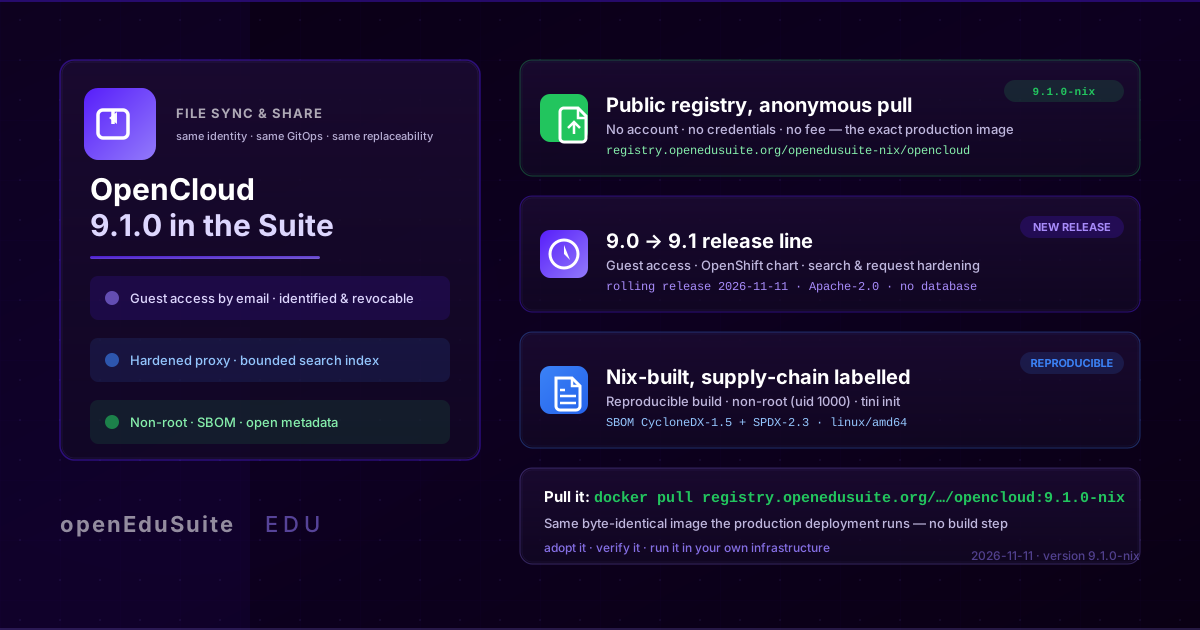
That artifact, openedusuite-nix/opencloud:9.1.0-nix, is now served by the openEduSuite public container registry. No account, no credentials, no fee:
docker pull registry.openedusuite.org/openedusuite-nix/opencloud:9.1.0-nix
What that image actually is (readable from its metadata, no pulling required):
- OpenCloud server 9.1.0, built for linux/amd64 the same day the upstream release appeared
- Runs as a non-root user via an init process (tini), without a database
- Apache-2.0 licensed, with version, source and SBOM labels attached (CycloneDX 1.5 and SPDX 2.3)
- Classified in the suite's basis protection labels as a file sync & share component with "enhanced" security level
The registry's public catalog already lists a growing set of Nix-built openedusuite-nix/* images alongside OpenCloud: agentflow, cloudnative-pg, dex, helmfile, k8up and postgresql. The pattern is the same for each: a versioned tag, open metadata, and no gate in front of the pull.
What this means for institutions
Publishing images publicly turns the supply chain into a commodity step for adopters:
- Same binary, no build step. An institution no longer has to compile OpenCloud itself or trust an importer. The public image is byte-identical to what the openEduSuite production deployment runs.
- Supply-chain verification stays possible. Because the image carries SBOM and signing metadata, adopters can verify what is inside before or after pulling it, instead of taking it on faith.
- Portability gains a concrete form. Combined with the public
openEduSuite-publicrepository (sanitized helmfile variants for OpenCloud and the other services, rendered offline), a deployment can be assembled from public, versioned artifacts end to end. - The sovereignty argument is unaffected. Pulling from a public registry does not change where the service runs: the container is still deployed and operated inside the adopting institution's own infrastructure.
The registry as an ongoing commitment
Public image publishing fits the rule the suite has followed since its first release: every service hangs off the same identity, ships through the same GitOps pipeline, and remains replaceable. A public registry makes that replaceability measurable: anyone can inspect the exact artifacts, compare versions, and fork the approach. The openEduSuite registry is at registry.openedusuite.org.
Call to Action
- Try it:
docker pull registry.openedusuite.org/openedusuite-nix/opencloud:9.1.0-nixand inspect the SBOM labels (docker image inspect). - Read more: the OpenCloud release notes for the full 9.0→9.1 changelog, and
openEduSuite-publicfor the helmfile variants. - Community: questions and deployment experience are welcome in the openEduSuite community: matrix channel
#opendesk-ce-public:matrix.openedusuite.org.
New version, same gate: every service stays replaceable, and now the image is yours to pull.