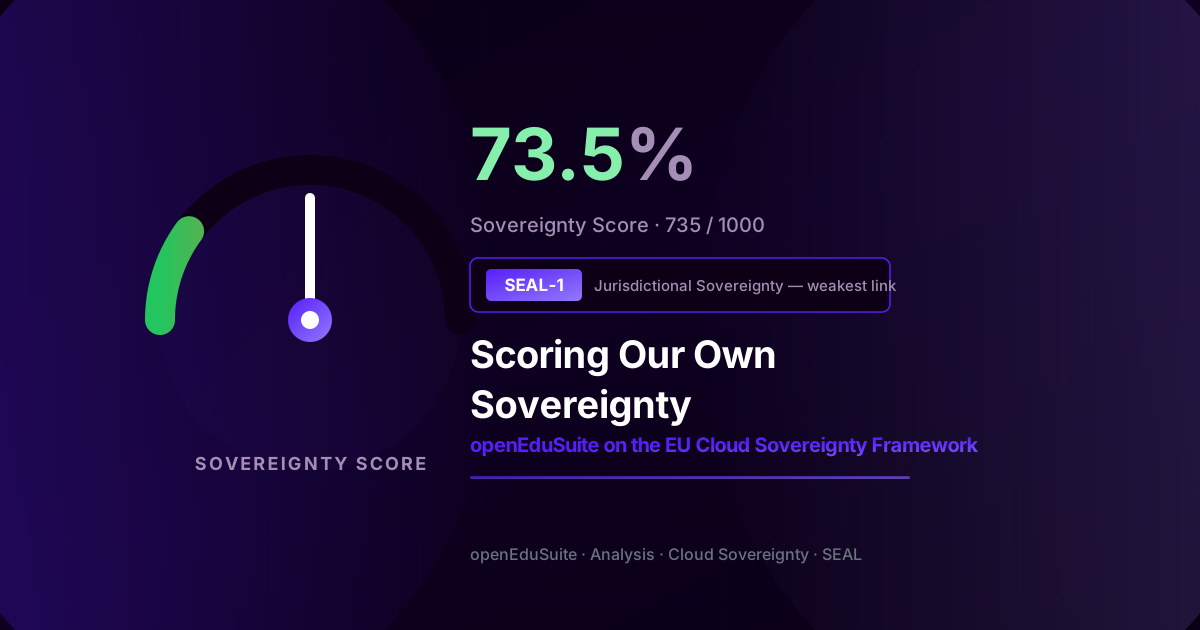
Scoring Our Own Sovereignty: openEduSuite on the EU Cloud Sovereignty Framework
"Cloud sovereignty" is easy to claim and hard to measure. An earlier post walked through the eight objectives of the EU Cloud Sovereignty Framework and read them against a self-hosted platform. Reading a framework against a hypothetical is one thing; scoring an actual deployment is another, because it produces numbers that can be checked.
We scored our openEduSuite reference cluster with the official framework methodology: all 48 criteria, the weighted Sovereignty Score, and the weakest-link SEAL level. This post reports the result, where the platform is strong, and where the result is capped.
What the Framework Measures
The EU Cloud Sovereignty Framework (v1.2.1) rates a cloud offering across eight objectives (SOV-1 to SOV-8) and 48 criteria. Each criterion is an ordinal ladder of answers; each answer carries a point value and a SEAL level (0 to 4). The point values feed the weighted Sovereignty Score, normalised to /1000. The SEAL level feeds the overall SEAL.
The decisive property is the weakest link: the overall SEAL equals the lowest SEAL reached on any single criterion. A provider can score well and still land at SEAL-1 if a single criterion is weak, for example hardware that a non-EU authority can compel. The score rewards strength on average; the SEAL does not.
flowchart LR
    A["Criterion answer<br/>(48 criteria across SOV-1 to SOV-8)"] --> B["Point value"]
    A --> C["SEAL level (0 to 4)"]
    B --> D["Weighted Sovereignty Score<br/>73.5 % (735 / 1000)"]
    C --> E["Overall SEAL = lowest SEAL<br/>across all criteria"]
    E --> F["SEAL-1 · Jurisdictional Sovereignty"]
What We Scored
The subject is the openEduSuite reference cluster from the Sovereign Cloud Days workshop: three reused Huawei RH2288E V2 servers (ca. 2013) running SCS-verified K3s on bare metal, with Ceph storage, Flannel, MetalLB, HAProxy and ArgoCD. It is operated on-premises at HRZ, Philipps-Universität Marburg, and carries openEduSuite's multi-tenant workloads plus a CPU-based Ollama inference path.
| Metric | Result |
|---|---|
| Sovereignty Score (weighted, /1000) | 73.5 % (735/1000) |
| SEAL (weakest link across all criteria) | SEAL-1 (Jurisdictional Sovereignty) |
The score and the SEAL diverge: a solid score and a low level, both derived from the same data.
Breakdown by Objective
| Objective | Weight | Score | Objective SEAL |
|---|---|---|---|
| SOV-1 Strategic Sovereignty | 20 % | 94 % | SEAL-4 |
| SOV-4 Operational Sovereignty | 15 % | 83 % | SEAL-3 |
| SOV-6 Technology Sovereignty | 15 % | 80 % | SEAL-3 |
| SOV-3 Data & AI Sovereignty | 10 % | 75 % | SEAL-1 |
| SOV-2 Legal & Jurisdictional | 10 % | 71 % | SEAL-1 |
| SOV-7 Security & Compliance | 15 % | 64 % | SEAL-1 |
| SOV-5 Supply Chain Sovereignty | 10 % | 50 % | SEAL-1 |
| SOV-8 Environmental Sustainability | 5 % | 19 % | SEAL-1 |
xychart-beta
    title "Sovereignty Score by Objective (%)"
    x-axis ["SOV-1","SOV-2","SOV-3","SOV-4","SOV-5","SOV-6","SOV-7","SOV-8"]
    y-axis "Score (%)" 0 --> 100
    bar [94,71,75,83,50,80,64,19]
Where the Platform Is Strong
SOV-1 Strategic Sovereignty (94 %, SEAL-4). The institution is its own provider. Control, ownership, funding and roadmap sit within the EU. This is the baseline every self-hosted platform should reach; the score confirms it.
SOV-4 Operational Sovereignty (83 %, SEAL-3). The cluster is operated by an EU-based team with no non-EU vendor lifeline. Upgrades, patching and troubleshooting are in-house; open standards and GitOps keep the workload portable. The remaining gap is formalisation, not capability.
SOV-6 Technology Sovereignty (80 %, SEAL-3). Everything is open source and runs on open standards (Kubernetes, Ceph, OIDC), and can be inspected, modified and redeployed by us. This is openEduSuite's core promise.
Where the Result Is Capped
The overall SEAL-1 is set by the criteria that cannot reach the higher levels.
SOV-5 Supply Chain (50 %, SEAL-1). The hardware (Huawei servers, Intel or Huawei components, opaque firmware) is of non-EU origin with only partial disclosure. This is the single largest drag, and it is a procurement decision we made deliberately to show that decommissioned hardware can still be useful. The software is sovereign; the reused hardware is not.
SOV-7 Security & Compliance (64 %, SEAL-1). The cluster is SCS-verified (6/6 KaaS standards, 444/444 CNCF conformance) and actively monitored, but SCS compliance is not a formal EAL certification, and independent audit rights are not yet fully used. The gap is procedural, not technical.
SOV-3 Data & AI (75 %, SEAL-1). Data stays on-premises in the EU, the keys are ours, and the AI path is auditable open source on CPU. What caps the objective is verifiable erasure: deletion is validated internally against policy but lacks independent, evidence-backed proof.
SOV-8 Environmental (19 %, SEAL-1). Reusing legacy hardware is sound practice, but we publish no PUE and no emissions figure.
What SEAL-1 Means
SEAL-1 is jurisdictional sovereignty: EU law applies to the operation, but critical dependencies remain outside EU control. For openEduSuite on this cluster that is an accurate description. The software, data and operations are ours; the silicon underneath is not.
This is a self-assessment, not a certification. Contracting authorities may weight the framework differently, and a real procurement would be audited. We publish the numbers because a score is only useful if it is reproducible; the 48-criterion answer set and the scoring script are in the assessment repository.
Getting from SEAL-1 to SEAL ≥ 3
Three steps:
- Address the hardware (SOV-5). Provenance disclosure or an EU-made platform fixes the structural weakness.
- Obtain a formal certification (SOV-7). Fill the gap between SCS verification and an EAL-recognised level.
- Publish environmental figures (SOV-8). PUE measurement, CSRD-aligned emissions reporting, and EU renewable energy.
Each step is a real project. That is why the weakest-link design matters: it does not let a strong objective compensate for a weak one. Sovereignty is not an average.
Conclusion
We ran this assessment to answer a question raised in every workshop: how sovereign is this deployment? The answer, in numbers, is 73.5 % with a SEAL-1 weakest link; strong where the software and its operation are concerned, and capped by the reused non-EU hardware, the lack of a formal certification and the absence of environmental reporting.
For institutions deciding whether to adopt such a platform, that is more useful than a claim. A self-assessment that names the weak link is a basis for a procurement decision.