openEduSuite Named a Winner of the HFD Ideas Competition on Digital Sovereignty
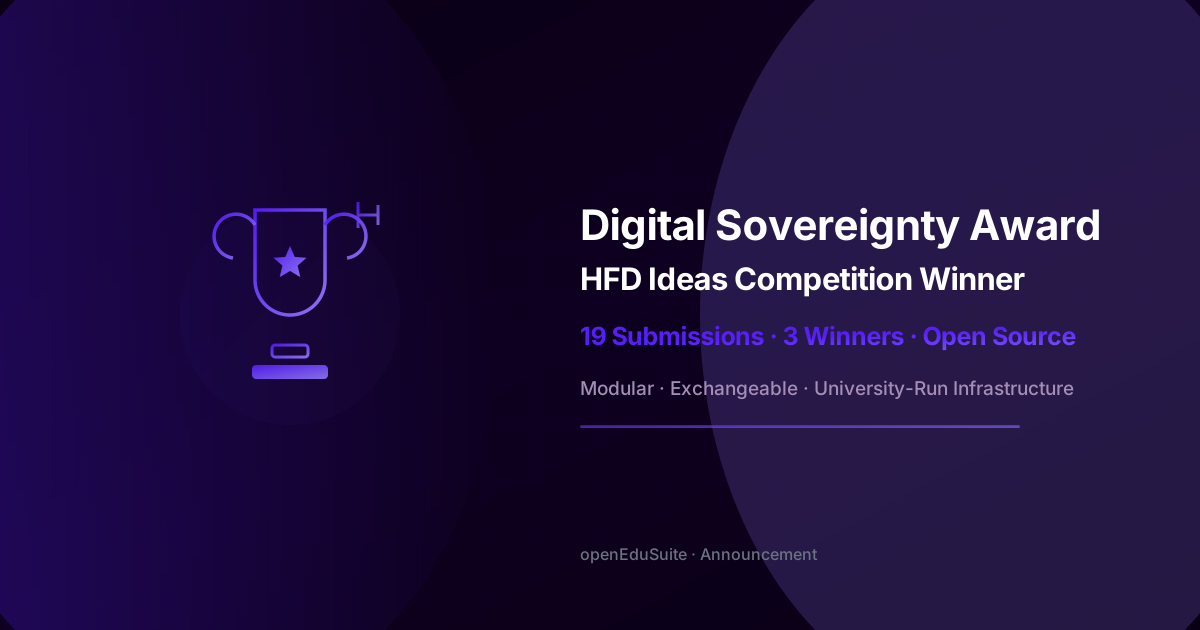
The Hochschulforum Digitalisierung (HFD), the German think tank for digitalisation in higher education, has announced the winners of its ideas competition on digital sovereignty, and openEduSuite is among the three award-winning projects. The competition drew 19 submissions from the DACH region, ranging from project sketches to running large-scale endeavours. Alongside openEduSuite, the jury selected two further projects: the innovation space for generative AI at the Karlsruhe Institute of Technology (GenAI@KIT) and LLMduckt from Graz University of Technology.
The Competition
At the end of July 2026, the HFD invited university project groups to submit ongoing or concretely planned initiatives on digital sovereignty, covering open source and data governance as well as sovereign cloud, AI infrastructure, and digital identities. The deadline closed on 31 August; in September an independent jury reviewed the submissions, and in early October the winners were announced.
The support is deliberately non-financial, focusing on people and reach instead: the HFD connects the award-winning projects with partners from its network so that good ideas can scale and be put to use at other universities, complemented by visibility through HFD channels and participation in HFD formats.
What the Jury Says About openEduSuite
"Exactly what is needed as a foundation. Finally an infrastructure for German universities!" (translated from German)
— Jury of the HFD ideas competition
That is precisely the idea behind openEduSuite: a modular, Kubernetes-native ecosystem that provides education services as exchangeable components. Every service can be replaced or extended individually without changing the platform as a whole. No lock-in to a large vendor, no monolithic all-in-one suite, but a foundation that universities operate, adapt, and develop under their own control. The system architecture overview and the article Reclaim Your Digital Sovereignty describe what this looks like in detail.
The Co-Winners
- GenAI@KIT (innovation space for generative AI at the Karlsruhe Institute of Technology): a development framework for the competent and responsible use of generative AI, from technological infrastructure to practical applications, with particular attention to people without prior knowledge.
- LLMduckt (Graz University of Technology): access to AI language models for teaching: chat interfaces and API keys distributed per person. Lecturers choose the models; the teaching system distributes the keys to the course. The jury explicitly highlighted the perspective of publishing it as open source as a bonus.
Together, the three projects show how broad the spectrum of digital sovereignty has become: from the infrastructure base through AI services to teaching integration.
What Comes Next
The award is a beginning, not a conclusion. The HFD will connect the winning projects with partners from its network; the award-winning initiative will be put into practice at a suitable university or university alliance. For openEduSuite, this means exchanging with institutions that want to build a sovereign education infrastructure, as a foundation to adopt, adapt, and shape.
That is exactly why feedback from higher-education practice is especially valuable right now:
- Share your needs: In the focus-group questionnaire (10–15 minutes), staff can indicate which services their institution really needs for teaching, research, administration, and the library.
- Share the operations perspective: The DevSecOps questionnaire (about 10 minutes) collects capabilities and requirements from IT operations, development, and security.
- Build with us: The architecture is openly documented; anyone who wants to add or replace services or run their own instance will find a starting point in the architecture overview.
Results from both questionnaires feed directly into the further development of the suite.
Awards are not an end in themselves; they confirm a direction: infrastructure that belongs to universities.
Trademark notice: Hochschulforum Digitalisierung (HFD) is an initiative of Stifterverband, CHE, and HRK. GenAI@KIT, LLMduckt, Kubernetes, and all other product and project names are trademarks of their respective owners. This article is independent and not affiliated with, nor endorsed by, these projects.