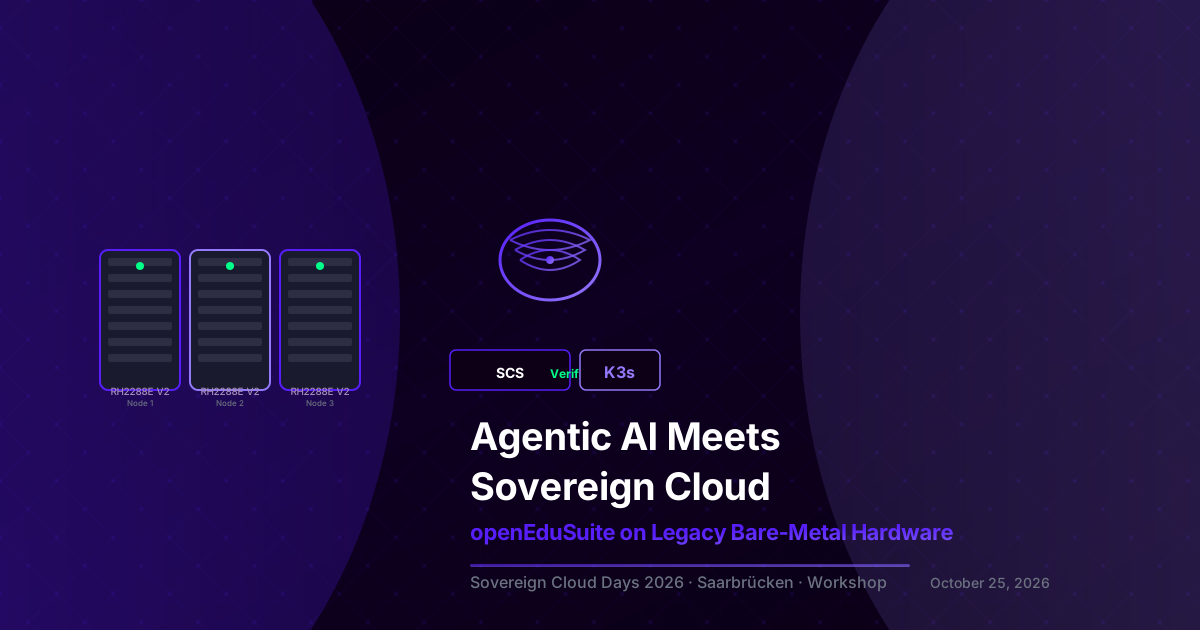
Agentic AI Meets Sovereign Cloud: openEduSuite on SCS-Verified Legacy Bare-Metal Hardware
What if your cloud's constraints became its superpower?
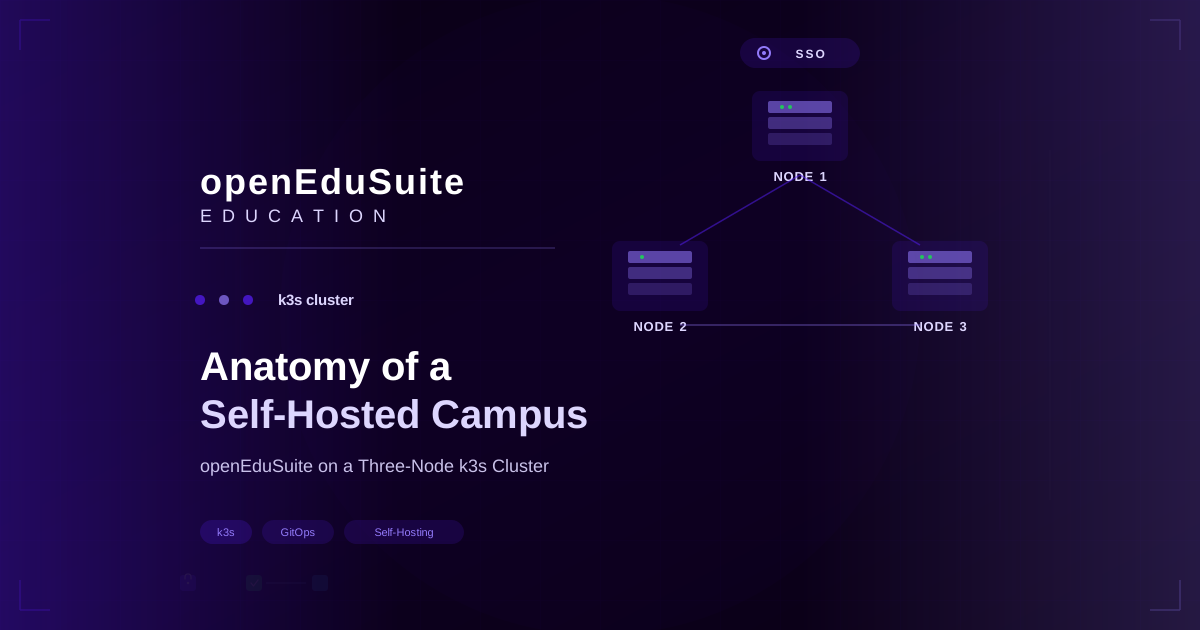
This was the central question of a session at Sovereign Cloud Days 2026 in Saarbrücken, where a practical case study demonstrated how openEduSuite — a sovereign, AI-powered educational platform — runs on a 3-node SCS-verified bare-metal K3s cluster built from legacy Huawei RH2288E V2 servers dating from approximately 2013. These are the kind of machines most teams would recycle rather than deploy for a modern cloud-native workload.
The Full Stack: From Legacy Hardware to Predictive Maintenance
The session walked through the complete architecture, proving that constrained hardware can deliver sophisticated capabilities:
Hardware Layer: Three repurposed Huawei RH2288E V2 servers, demonstrating that hardware typically considered end-of-life can still power a modern sovereign cloud platform.
Platform Layer: A lean bare-metal K3s installation with Ceph for persistent storage, Flannel for networking, MetalLB for load balancing, HAProxy for ingress, and ArgoCD for GitOps deployment. This stack achieved full compliance: 6/6 KaaS standards PASS and 444/444 CNCF conformance.
Agentic Layer: A predictive maintenance agent implementing Kalman filter and Markov chain risk scoring. This agent monitors cluster health in real-time, analyzing metrics to detect anomalies before they become outages. Instead of reacting to failures, the system alerts operators proactively — a significant operational advantage for education environments where uptime is critical.
The theme of the talk was captured by the German proverb: "Not macht erfinderisch" — necessity breeds invention. Constrained hardware and upstream software bugs forced pragmatic engineering decisions, resulting in a reproducible, well-documented setup.
Lessons from the Trenches: The OpenStack/OVN Detour
The journey to this architecture was not direct. An earlier phase attempted to deploy on OpenStack with OVN networking, using virtual machines instead of bare metal. This approach collapsed on a bug in OVN 25.03.1 related to gateway redirect, which broke floating IP functionality — a critical requirement for the multi-tenant workloads.
Rather than waiting for an upstream fix or working around the limitation, the team made a strategic pivot: ditch the virtual machines and move the workloads directly to SCS-verified bare metal. This decision eliminated the OVN dependency entirely and provided a more predictable, performant foundation.
The absence of GPUs on the legacy servers was addressed through quantization and deterministic scheduling. Model quantization reduces the precision of AI model parameters, significantly decreasing memory usage and computational requirements with minimal impact on output quality. Combined with deterministic scheduling — which ensures consistent performance by reserving resources — the system compensates for the missing GPU acceleration.
Hands-On Workshop: Sovereign AI without API Keys
A distinctive element of the session was its interactive workshop component. Participants installed opencode on their own laptops, connected to the free Big Pickle model, and ran their first prompts against real cluster documentation. This hands-on exercise demonstrated sovereign AI in practice: no API keys required, no cost, and complete data locality.
The workshop underscored a key principle of digital sovereignty: control over your own data and infrastructure. By running local models against their own documentation, participants experienced firsthand how AI capabilities can be delivered without external dependencies.
All Materials Available
All presentation materials, runbooks, and compliance artifacts from the session are available in the dedicated repository:
https://github.com/tobias-weiss-ai-xr/sovereign-cloud-days-2026
Key Takeaways
-
Constraints drive innovation: Legacy hardware and software limitations forced creative architectural decisions that resulted in a robust, compliant platform.
-
Standards compliance is achievable: The SCS-verified bare-metal K3s cluster passed all KaaS standards and achieved full CNCF conformance — proof that sovereign cloud does not require cutting-edge hardware.
-
Predictive operations are practical: Proactive monitoring with agentic AI is not just a concept for well-funded teams. It is achievable with open-source tools and pragmatic engineering.
-
Sovereign AI is real: Running local models without external dependencies demonstrates that AI capabilities can be delivered while maintaining complete control over data and infrastructure.
Call to Action
-
Try it yourself: Clone the repository and follow the runbooks to deploy a similar stack on your own hardware.
-
Review the compliance artifacts: Examine the SCS verification documents to understand what standards compliance looks like in practice.
-
Join the community: Participate in discussions about sovereign cloud and agentic AI at the openEduSuite Matrix channel:
#opendesk-ce-public:matrix.openedusuite.org.
When constraints become superpowers: sovereign cloud on legacy hardware with predictive AI operations.